

Artificial intelligence has moved rapidly from experimentation to everyday use. In India, this shift is visible not only in technology companies but also in classrooms, assessment systems, hiring processes, and skill evaluation frameworks. AI is no longer an optional enhancement—it is reshaping how learning is delivered, how progress is measured, and how careers evolve.
Understanding how AI is changing education in India requires looking beyond tools and platforms. The real transformation lies in how knowledge is accessed, personalised, and applied—and how learners prepare for a workforce that increasingly relies on intelligent systems.
Takeaway: AI is not changing education one subject at a time; it is changing the structure of learning itself.
- What is the role of AI in education today?
- How does AI affect students as learners?
- What are the benefits of AI in education?
- What are the disadvantages and risks of AI in education?
- How is AI changing careers in India?
- What skills are needed in the AI era?
- Will AI replace teachers and human roles?
- How institutions are responding to AI-led change
- Conclusion
What is the role of AI in education today?
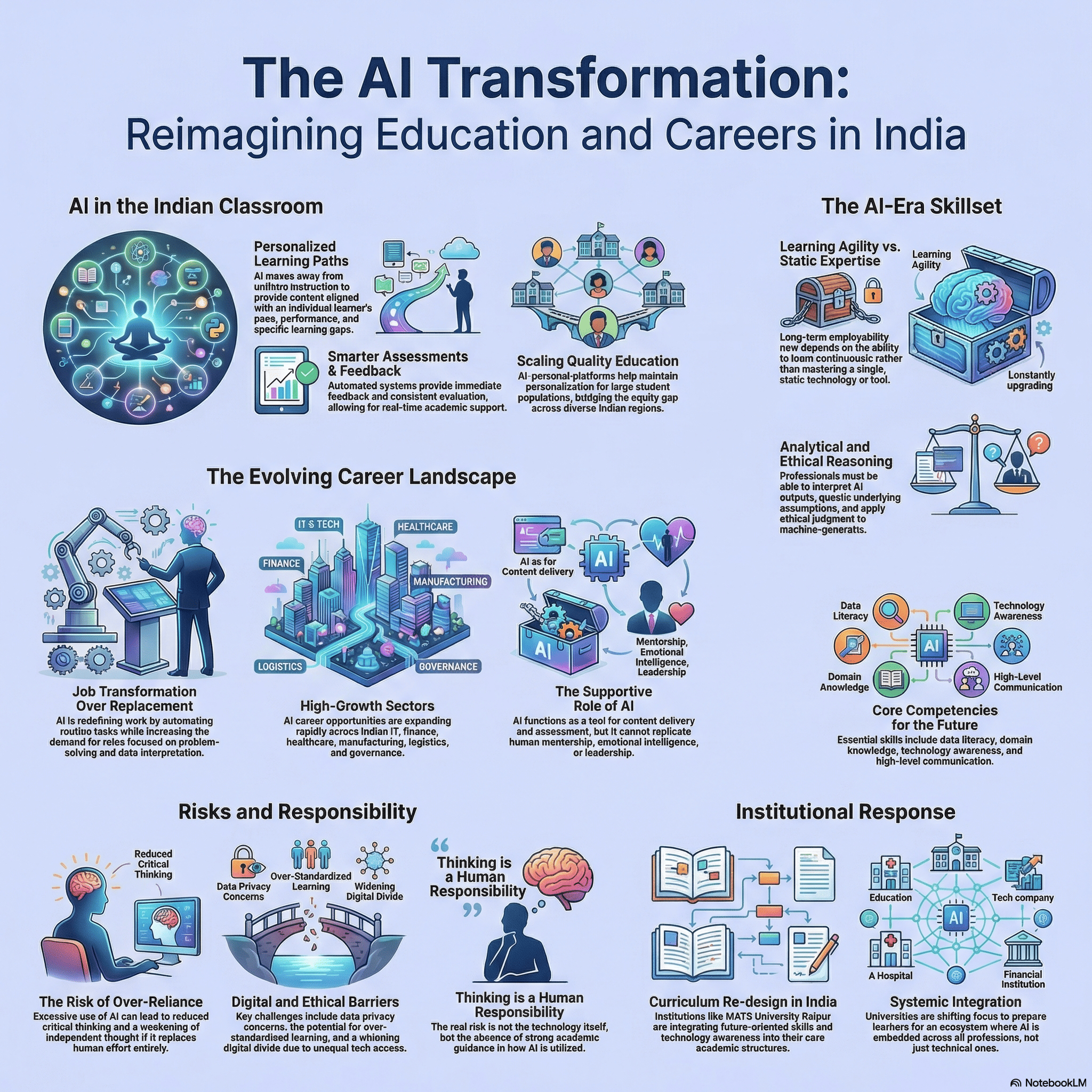
The role extends across teaching, learning, and evaluation. AI systems now support adaptive learning paths, personalised feedback, automated assessments, and data-driven academic planning. Instead of uniform instruction, learners increasingly receive content aligned to their pace and performance.
At an institutional level, AI helps educators identify learning gaps, predict outcomes, and refine curriculum design. This has made Artificial Intelligence education in India more outcome-oriented, with a stronger link between academic input and learner performance.
-
How is AI changing education in India?
AI is enabling personalised learning, smarter assessments, data-driven academic support, and improved access to education across regions.
How does AI affect students as learners?
The AI impact on students is both practical and psychological. On the positive side, students benefit from immediate feedback, customised study paths, and flexible access to resources. Learning becomes less dependent on fixed schedules and more responsive to individual needs.
At the same time, students must develop judgement—knowing when to rely on AI support and when to think independently. This balance is now a critical part of modern education.
Takeaway: AI supports learning, but thinking remains a human responsibility.
What are the benefits of AI in education?
The benefits are most visible in scale and accessibility. AI-powered platforms can support large student populations while maintaining personalisation, something traditional systems struggle to achieve.
Key benefits include:
- Adaptive learning experiences
- Faster and more consistent evaluation
- Early identification of learning gaps
- Wider access to quality educational resources
These advantages are particularly relevant in a country as diverse as India, where access and equity remain major challenges.
For academic and administrative support, reach out via the MATS University Contact Number
What are the disadvantages and risks of AI in education?
Despite its advantages, AI is not without limitations. The disadvantages of AI in education often stem from over-reliance and misuse rather than the technology itself.
Risks include:
- Reduced critical thinking if AI replaces effort
- Data privacy and ethical concerns
- Unequal access to technology
- Over-standardisation of learning experiences
-
What are the risks of relying on AI in education?
Excessive reliance can weaken independent thinking, raise data privacy issues, and widen digital divides if access is uneven.
Controlled contradiction
AI is often seen as a threat to learning depth. In practice, the real risk is not AI
itself—but the absence of strong academic guidance in how it is used.
How is AI changing careers in India?
Beyond education, AI is redefining work itself. AI career opportunities in India are expanding across sectors such as IT, finance, healthcare, manufacturing, logistics, and governance. At the same time, many traditional roles are being reshaped rather than eliminated.
The shift is not about job loss alone—it is about job transformation. Roles now demand analytical thinking, technological awareness, and adaptability.
-
How is AI changing careers?
AI is automating routine tasks while increasing demand for roles that require problem-solving, data interpretation, and strategic decision-making.
What skills are needed in the AI era?
The skills needed in AI era go beyond coding or technical expertise. Employers increasingly look for professionals who can work with AI systems rather than compete with them. The AI era does not prioritise technical skills alone; it reshapes the balance between human capability and machine assistance. While basic data awareness and digital literacy are important, the most critical skills are analytical thinking, problem framing, and contextual judgement. Professionals must be able to interpret outputs generated by AI systems, question assumptions, and apply insights within real-world constraints.
Communication skills, ethical reasoning, and the ability to learn continuously also become central, as AI tools evolve faster than formal curricula. In this environment, long-term relevance depends less on mastering a single technology and more on developing adaptability, reasoning, and domain understanding.
These skills include:
- Data literacy
- Analytical and critical thinking
- Domain knowledge combined with technology awareness
- Ethical reasoning and judgement
- Continuous learning ability
These capabilities define long-term employability more than any single tool or platform.
Takeaway: In the AI era, relevance comes from learning agility, not static expertise.
Will AI replace teachers and human roles?
This is one of the most common concerns. AI is often framed as a replacement for human roles, but in education and professional settings, its function is largely supportive rather than substitutive. In teaching, AI can assist with content delivery, assessment, and personalised feedback, but it cannot replicate mentorship, emotional intelligence, ethical guidance, or contextual decision-making.
Similarly, in careers, AI automates routine tasks but increases the importance of human oversight, leadership, and accountability. Rather than replacing teachers or professionals, AI reshapes their roles—freeing them from repetitive work while amplifying the need for judgement, creativity, and responsibility.
-
Can AI replace teachers in the future?
AI can support teaching, but it cannot replace the human role of mentoring, judgment, ethical guidance, and contextual understanding.
How institutions are responding to AI-led change
Universities across India are rethinking curriculum design, assessment models, and skill development frameworks to respond to AI-driven change. Institutions such as MATS University Raipur reflect this broader shift by integrating technology awareness and future-oriented skills into academic structures while maintaining institutional governance and academic responsibility.
The goal is not to teach AI in isolation, but to prepare learners for an ecosystem where AI is embedded across professions.
Conclusion
AI is reshaping education and careers in India at a systemic level, influencing how knowledge is delivered, how skills are developed, and how work is performed. While AI brings clear benefits in accessibility, efficiency, and personalisation, it also demands stronger human judgement, ethical awareness, and independent thinking. For students and professionals alike, the challenge is not whether to engage with AI, but how to do so responsibly.
In this evolving landscape, education must focus not only on technology adoption but on building adaptable, thoughtful individuals who can navigate an AI-enabled future with clarity and confidence.